
Inside the thirty-minute run
On October 12, Atlas completed a production supplier-verification run across 47 documents, newly evaluated 2,539 selected question instances, and saved an assessment report in 30 minutes and 29 seconds. None of those selected answers had been carried over from an earlier run. The estimated model-processing cost was $11.22. The report brought the results together with the questions still awaiting validation or further evidence, giving the team a record it could inspect and continue working from.
The significance is in the kind of work that becomes practical at that cost. A supplier packet contains names, dates, claims, relationships, and supporting statements that need to be understood together. A summary can make the packet shorter to read. A structured investigation can ask what each part establishes, how it relates to the supplier under review, and which conclusions still need evidence or validation.
That is the purpose of the updated Atlas supplier record: to keep the assessment connected to the investigation that produced it. This run completed processing and report generation. It did not establish supplier clearance or finish every answer-level review. Those are distinct outcomes, and a useful record needs to make both the completed work and the remaining obligations clear.
Why a packet becomes weeks of work
Supplier verification tends to expand as it proceeds. A company name on one document prompts a check against another. A certificate describes a facility, while the transaction involves a related legal entity. A date changes which version of a document applies. An answer that looked straightforward at the beginning becomes conditional on a file that has not yet arrived. The reviewer is doing more than reading: they are maintaining a growing set of relationships and unresolved questions.
The elapsed process can stretch over days or weeks because those questions move through people and systems. Someone requests a document, another person reviews it, and the next question waits for the first response. Some of that time will remain outside the control of AI. A supplier still has to provide missing evidence, and a responsible person still has to make the decision. But the examination of material already in hand can happen earlier and in greater depth.
That is the opportunity we care about. If the first pass can organize thousands of focused checks and make their dependencies visible, the team can spend its attention on the questions that need judgment or follow-through. The work becomes easier to manage because its unresolved parts are explicit.
Thousands of small decisions, one larger investigation
Atlas separates two kinds of reasoning that are often compressed into a single instruction to a large model. The first is a focused decision against relevant evidence: does this document name the entity being reviewed, does a stated date support the claim, or is the available text sufficient to answer the question? These decisions benefit from constrained choices and defined inputs. The second is the broader investigation: understanding why an answer matters, comparing it with other results, consulting available sources, and deciding what to examine next.
Atlas uses Jev for focused decision tasks alongside a broader language-model investigation. Each layer has a different job. A narrow question can be evaluated against defined evidence, while the broader investigation works through context and relationships. That division lets us examine where specialized models are useful and where additional reasoning or human review is needed.
The same separation makes model testing more useful. We can compare how models handle a defined question and its supporting evidence, then examine the review required afterward. The question definitions, evidence relationships, validation requirements, and investigation history remain part of Atlas when an individual model changes.

Integration means keeping the decision connected to its evidence
Integrating Jev into Atlas means more than sending a question to another model. A focused evaluation has a subject, a question definition, criteria, and the particular evidence it is allowed to use. Atlas retains those relationships through the request and back into the verification record, so the returned answer can be understood as part of the investigation.
Even when several questions share source material, each answer remains connected to its own question and relevant evidence. The answer returns to the verification record with its validation status and any required review visible. A reviewer can therefore distinguish what the model concluded from what has been checked and what still needs attention.
That connection is what makes a specialized decision model useful in a larger workflow. The supplier record can show which question was evaluated, what evidence supported it, and what still needs review. Our model-testing work uses saved question inputs to examine alternatives without treating a previous model verdict as the answer key.

The supplier record has to show its work
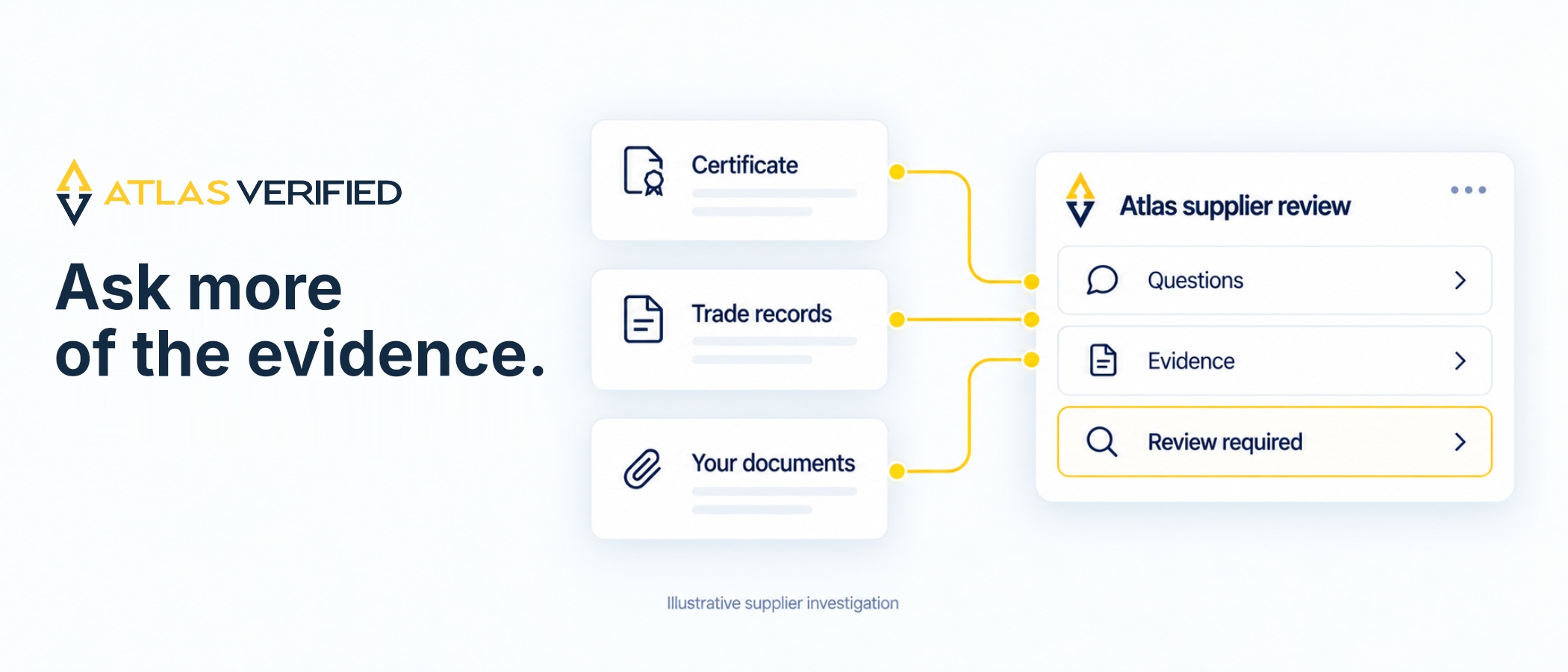
A useful result cannot disappear into a paragraph saying that a supplier looks acceptable or needs further review. A person needs to understand which question produced a finding and what supports the answer. The updated supplier record brings those parts closer together. Document-level evaluations and supplier-wide questions can contribute to the assessment while retaining the distinctions needed to inspect them.
Consider two questions that both remain unresolved. One lacks the document needed to answer it. The other already has relevant source evidence, but its answer requires another level of validation. They may look similar in a high-level count, yet they require different next steps. The first calls for more evidence; the second calls for review. Sending another document request in both cases wastes time and makes the process harder for everyone involved.
Entity relationships need the same care. A document about a related company may be relevant without proving a claim about the supplier being assessed. A name mismatch can warrant investigation without establishing fraud. Keeping the subject entity, related entities, source material, and answer status distinct makes it possible for a reviewer to follow the reasoning rather than accept the final wording on trust. That is the product value of preserving the questions, not just the assessment they help produce.

A completed run, with a record of the work ahead
The October 12 run successfully completed processing and saved its assessment report. Most selected answers still required validation or further evidence. That distinction matters: an answer awaiting review may already have relevant source material, while an answer lacking evidence needs additional information. The unresolved answers cannot be treated as a count of missing documents, incorrect answers, or adverse findings about the supplier.
The benchmark demonstrates the amount of evaluation work completed, the time it took, and the creation of an inspectable assessment. It does not establish accuracy against a human-labelled answer set, and it should not be read as a clearance decision. Keeping that boundary explicit lets us measure progress without asking a processing benchmark to prove something it did not test.
The $11.22 figure is a scoped model-processing estimate for this historical run. It combines recorded Jev charges with estimated broader-model usage and excludes earlier rescans, unreported failed-call usage, and separately billed work. It is neither a customer price nor an all-in verification cost. Later experiments used different workloads and review requirements; their lower recorded costs do not replace this completed-run benchmark.
Spend the cost savings on depth
As model costs fall, we see an opportunity to ask more of the evidence. A lower processing bill is valuable, but it becomes more consequential if it lets a team examine relationships that would otherwise receive little attention. The ambition is a deeper first investigation and a clearer account of the questions worth pursuing afterward.
Atlas already supports the feedback loop between these two reasoning layers. An investigation can create a follow-up question, bind the relevant evidence to it, send it for focused evaluation, and retain the link to the answer that prompted it. The October 12 benchmark created no new follow-up question records, so that particular run did not demonstrate the loop. The capability was already implemented; demonstrating its reliability across further investigations is a separate measurement task.
Supplier, shipment, and inventory investigations already share this architecture. Across those domains, documents refer to records, records refer to other entities, and a conclusion depends on understanding the relationships. Our continuing work is to improve evidence coverage, reviewed correctness, latency, and cost while keeping those relationships visible to the people responsible for the decision.
The thirty-minute run gives us a concrete result to build on: thousands of new evaluations and a saved assessment within one working session. The next question is how much more useful that investigation can become as the models improve and the cost of asking another well-defined question falls. The supplier record is where that work stays connected, reviewable, and ready to continue.